Bills Introduced – 9-8-25
Yesterday, with both the House and Senate in session, there were 62 bills introduced. One of those bills will receive additional coverage in this blog:
HR 5167 To authorize appropriations for fiscal year 2026 for intelligence and intelligence-related activities of the United States Government, the Community Management Account, and the Central Intelligence Agency Retirement and Disability System, and for other purposes. Crawford, Eric A. "Rick" [Rep.-R-AR-1]
Intel Authorization Act
HR 5167 will be similar to HR 8512, Intelligence Authorization Act for Fiscal Year 2025, that was introduced by Rep Turner (R,OH) on May 22nd, 2024. That bill was ordered favorably reported by the House Intelligence Committee on June 11th, 2024 with the written report published on September 11th, 2024. No further action was taken on this bill, but an intel authorization act was included as Division F of HR 5009, the Servicemember Quality of Life Improvement and National Defense Authorization Act for Fiscal Year 2025, that became law (PL 118-159) on December 23,2024.
Space Geek Legislation
I would like to mention one bill under my limited Space Geek coverage in this blog:
HR 5175 To require the Secretary of Defense to initiate discussions, through the Quad, with Australia, India, and Japan to identify mutual areas of interest with respect to the formulation of best practices in space, cooperation on space situational awareness, and space industrial policy, and for other purposes. Crow, Jason [Rep.-D-CO-6]
I can find no legislation in the 118th Congress that would seem to be similar to HR 5175. While DOD certainly has an interest in these topics, given the increasingly developed commercial space industry, they may not be the most appropriate agency to conduct discussions about the formulation of best practices in space, cooperation on space situational awareness, and space industrial policy.
MIP Legislation
I would like to mention in passing two bills that will not receive additional coverage in this blog:
S 2733 A bill to require the Comptroller General of the United States to analyze certain legislation in order to prevent duplication of and overlap with existing Federal programs, offices, and initiatives. Paul, Rand [Sen.-R-KY]
S Res 377 An executive resolution authorizing the en bloc consideration in Executive Session of certain nominations on the Executive Calendar. Thune, John [Sen.-R-SD]
S 2733 would appear to be similar to S 780, the Duplication Scoring Act of 2023, that was introduced by Paul in March of 2023. It was ordered favorably reported by the Senate Homeland Security and Governmental Affairs Committee in that same month. The committee report was published in May 2023. No further action was taken on the bill in the 118th Congress. This is a motherhood and apple pie topic near and dear to Paul’s limited-government heart. The earlier bill did not contain any requirements to eliminate ‘duplication and overlap’ (just public reporting), but that may change in this version as Paul is now the Chair of the HSGA committee.
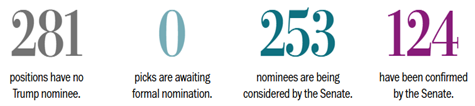
S Res 377 has no counterpart in the 118th Congress. It has been called in the press (see here for example) a ‘nuclear option’. The details are not yet available (still being worked out I would suspect), but it would help the Republicans speed up the consideration of some presidential appointments by allowing for some number of nominees for certain positions to be considered en bloc on the floor of the Senate. While there has been some concern (massive understatement) about the quality and qualifications of many Trump appointees, it has become a very time-consuming process in the Senate to confirm these folks in the first year of a new administration. The Washington Post has an excellent web page dedicated to tracking the process of approving presidential nominees. They are following (see graphic below) just 822 of the 1,300 positions which require Senate advice and consent. And the problem this year is aggrevated by the ‘failure’ Democrats to cooperate in any way in much of the approval process. Even in the best of years, this is a burden on the Senate that limits the time the body can take on looking at legislation. This may be a legitimate effort to address the problem, even though it is certainly currently being driven by presidential ire.